GEO/LLMO: Content Traps, Cognitive Archetypes and the Future of AI Visibility
Search is changing not incrementally, but structurally.
We are moving from a world where users clicked links to one where AI generates answers directly.
And that shift changes a fundamental question for every marketer and content strategist:
How do you create content that AI chooses to use?
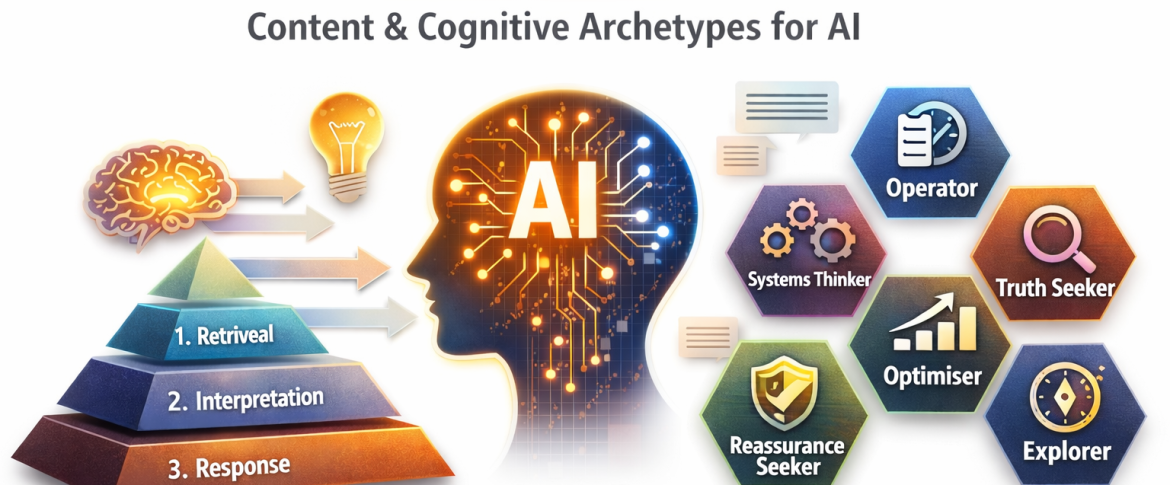
The answer is not a new set of SEO rules. It requires understanding both how AI systems process content and how the humans prompting those systems think.
This is the foundation of the Ethinos GEO Framework — built on two interlocking ideas:
- Structure (LLMO) — how content is understood, extracted and reused
- Cognition (Cognitive Archetypes) — how content aligns with different ways of thinking
AI doesn’t reward content that ranks, it rewards content it can reuse.
In this article I will lay out our full framework — including a dimension that most LLMO writing still overlooks: the role of AI memory and user profiling in shaping which content gets surfaced.
—
Why Most LLMO Advice Falls Short
A lot of content optimisation advice for AI looks like SEO with a new label. It focuses on structure, headings and crawlability — all useful, but incomplete.
The fundamental difference is this:
Search engines rank pages. LLMs reconstruct answers.
A search engine retrieves and orders pages. A large language model synthesises a response by combining, interpreting and reframing information from multiple sources.
Once you understand this, most traditional optimisation approaches start to break down. You are no longer competing for rankings. You are competing to be used.
How LLMs Actually Use Your Content
Content must pass through three layers before it contributes to an AI-generated answer:
- Retrieval — Can your content be found?
- Interpretation — Can it be understood?
- Response — Can it be reused in an answer?
Most content performs reasonably well at the first two layers. The biggest gap — and the biggest opportunity — is at the third.
If your content can’t be lifted into an answer, it won’t be used.
The 80/20 of LLMO/GEO
The highest-leverage actions are:
- Structure — clear hierarchy and formatting
- Reasoning — explain why, not just what
- Extractability — write ideas so they stand alone
Structure drives visibility. Reasoning drives reuse.
If You Do Only One Thing
Write every key idea so it can stand alone and be reused.
This one shift improves how content is interpreted, extracted and reused across AI-generated responses.
—
The ONE thing everyone is missing is: How AI Models the User
This is the dimension that most LLMO/GEO writing strategies do not address.
AI systems with persistent memory (E.g. ChatGPT) do not just respond to the prompt in front of them. They respond to what they know about the person asking.
Over repeated interactions, these systems build a cognitive profile of the user: how they prefer information framed, whether they want steps or frameworks, whether they gravitate toward risk assessment or possibility, data or narrative.
The model decides which parts of your content to use, based on who is asking.
The same question asked by two different users can produce two materially different answers. Not because the model found different sources, but because it synthesised the same sources differently to match each user’s cognitive profile.
The implication for content creators is simple:
If your content only speaks to one cognitive state, it limits how often it can be used.
—
The Ethinos 6 Cognitive Archetypes
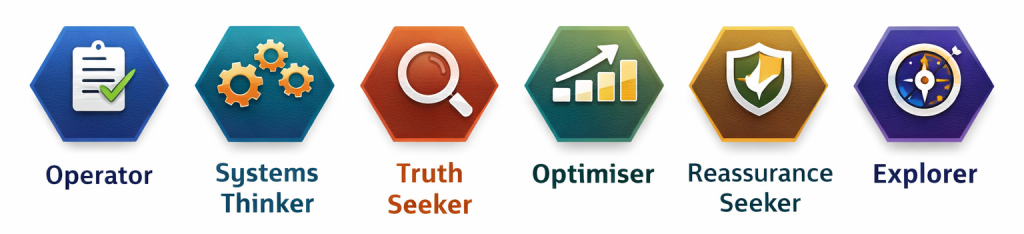
Through analysis of how different users prompt and how models respond, six distinct cognitive archetypes emerge. These are not fixed personality types. They are thinking states — different ways people seek, process and act on information.
- ⚙️The Operator: wants clear actions and steps
- 🔗The Systems Thinker: wants structure and models
- 🔍The Truth Seeker: wants first principles and underlying logic
- ⚖️The Optimiser: wants trade-offs and comparisons
- 🛡️The Reassurance Seeker: wants risk clarity and confidence
- 🌐The Explorer: wants broader context and possibility
A single user may move between these archetypes depending on context, stakes and familiarity with the topic.
—
The Core of Our framework: Develop – “Content Traps”
Understanding the archetypes leads directly to the most actionable concept in the framework: content traps.
A content trap is a statement or section designed to act as an attractor for a specific cognitive archetype. It gives the AI something relevant to pull depending on the user it is responding to.
It does not need to be labelled. It just needs to exist in a usable form.
Great AI-era content does not just answer one question. It contains multiple entry points (i.e. content traps) for different ways of thinking.
What Content Traps Look Like in Practice
Take a single product or service. The same underlying offering can be framed in different ways depending on which archetype the AI is responding for.
| Archetype | Example content trap |
|---|---|
| 🌐 Explorer | “The product everyone in your industry is already moving toward.” |
| 🔍 Truth Seeker | “Independent trials show a 43% improvement in output quality.” |
| 🔗 Systems Thinker | “Built on adaptive neural architecture – here is how it works.” |
| 🛡️ Reassurance Seeker | “Passed 12 independent safety audits across three regulatory frameworks.” |
| ⚙️ Operator | “Three steps from onboarding to live deployment.” |
| ⚖️ Optimiser | “Compared against leading alternatives: where it wins and where it doesn’t.” |
None of these statements contradict each other. They can — and should — coexist within a single piece of content.
Each one gives the model a different entry point depending on who is asking, what they need, and how they think.
Content that only satisfies one cognitive state leaves the majority of AI synthesis opportunities on the table.
—
How to Apply the Framework
Arrrrgh! not more content… I hear you say!
Don’t worry! The goal is not to create six separate pieces of content. The goal is to build layered thinking into one piece.
Great content has one dominant structure and multiple embedded perspectives.
- Systems Thinker: introduce a clear framework or model
- Operator: add actionable steps or prioritised next moves
- Truth Seeker: explain the underlying logic
- Optimiser: include trade-offs and comparisons
- Reassurance Seeker: address risks and limits directly
- Explorer: provide context, vision or broader implications
What To Do in Practice
- Structure content so key ideas are easy to extract
- Write insights that do not rely on surrounding context
- Include multiple cognitive entry points within one piece
- Focus on clarity over cleverness
- Design for reuse, not just ranking
The question to ask of any content is not “Which archetype is this for?” but “Which archetypes can find themselves in this?”
—
Understanding the Trade-offs
Optimising for AI-driven discovery involves trade-offs.
- Structure vs readability: highly structured content is easier for AI to extract, but excessive formatting can reduce narrative flow
- Clarity vs depth: simplified explanations improve reuse, but may reduce nuance
- Traffic vs reuse: content used in AI answers may not always drive clicks
Optimising for AI is about prioritisation — not maximisation.
In most cases, prioritising clarity and extractability delivers the highest impact.
—
What This Framework Does Not Solve
I should be direct about the limits of this approach. It is not a magical silver bullet to AI visibility.
- It won’t fix weak ideas
- It won’t replace expertise
- It won’t guarantee traffic or citations
- Its impact is stronger in AI systems where persistent memory and user profiling are active
What it does do is increase the probability that strong content gets reused across a wider range of AI-generated responses and for a wider range of users.
—
AI Memory and AI Model Differences
The cognitive archetype dimension of this framework becomes more powerful as AI memory and personalisation become more common.
Some systems currently show this more strongly than others. Over time, that difference is likely to narrow as persistent memory becomes standard across AI solutions.
For content strategists, the implication is not to chase individual user profiles. It is to ensure your content has enough cognitive range that it remains useful regardless of which direction personalisation pulls.
—
The Bottom Line
Search is no longer just about ranking. It is about influence — specifically, the ability to shape the answers that shape decisions.
If your content can’t support a decision, it won’t shape an answer.
The content that gets reused across AI-generated answers is not the content best optimised for a keyword. It is the content that contains enough cognitive surface area to serve different minds asking the same question.
Structure your content so it can be extracted. Reason through it so it earns reuse. And embed the content traps that ensure, regardless of who is asking, and what AI knows about them, your content has something worth surfacing.
The brands that win won’t just rank, they’ll become the default sources AI turns to.

Benedict Hayes is Co-Founder of Ethinos and a specialist in search and AI-driven discovery. With 25+ years in digital, he now focuses on Generative Engine Optimisation (GEO) and is building Intelidex.ai to help brands adapt to AI-first search.
He is actively working on defining GEO as the next evolution of search, where visibility is determined not by rankings, but by how content is reused in AI-generated answers.

what do you think?